

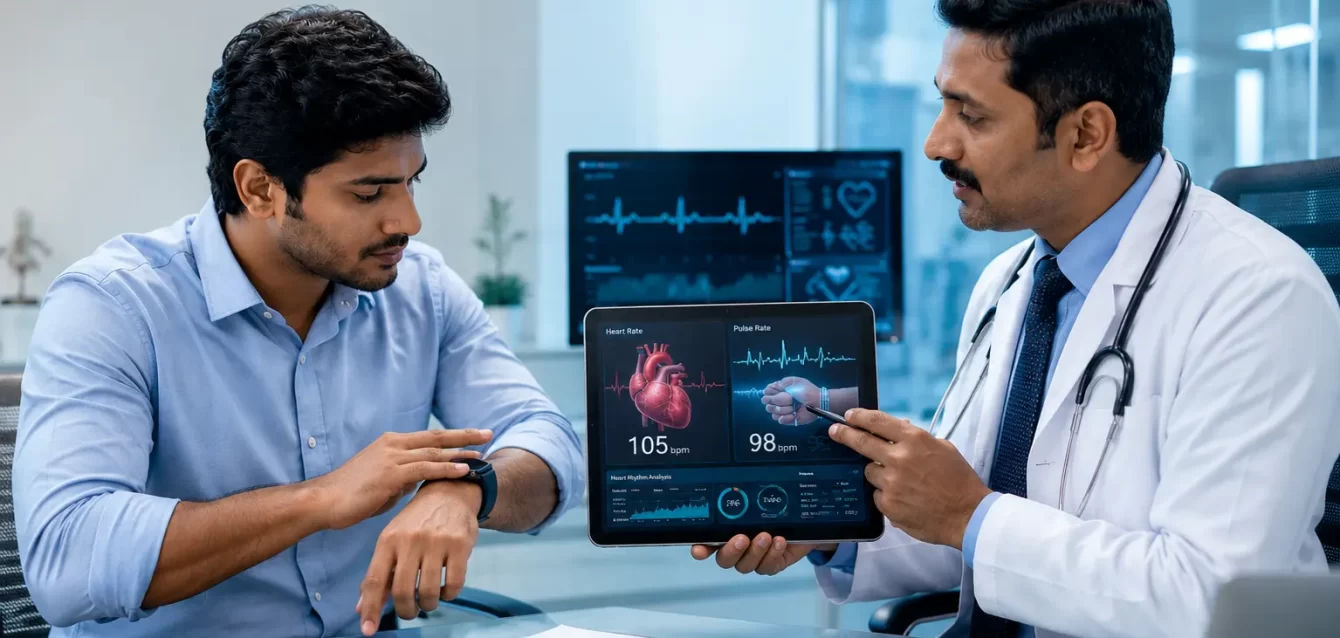
Your smartwatch suddenly shows 125 beats per minute while you are sitting quietly. A few seconds later, you place your fingers on your wrist and start counting your pulse. It feels slower than what the watch just displayed.
Most people would immediately think the watch is wrong.
Interestingly, doctors know that there are situations where your heart and your pulse may actually tell slightly different stories. Understanding the Normal Heart Rate and pulse rate becomes important because many people assume they always mean the same thing. A patient sitting in a cardiology consultation room may say, “Doctor, I can feel my heart racing, but my pulse does not feel very fast.” Questions like these are more common than many people think.
Most of us use the words heart rate and pulse rate interchangeably. In many cases, they match. But medicine often becomes interesting when things stop behaving normally.
What Is the Difference Between Heart Rate and Pulse Rate?
Heart rate is the number of times the heart beats in one minute. It tells doctors how frequently the heart muscle contracts.
Pulse rate is the number of pulse waves that can actually be felt in the arteries during one minute, commonly at the wrist or neck.
Under normal conditions, every heartbeat pushes blood with enough force to create a pulse wave. So if the heart beats 72 times, the pulse also usually feels like 72.
But not every heartbeat behaves perfectly.
Why Some Heartbeats Do Not Create a Pulse
One of the lesser-known facts in heart medicine is that some heartbeats can occur without creating a detectable pulse.
Doctors sometimes compare this to repeatedly pressing a water pump.
If every push is strong, water flows consistently. But if some pushes are weak, the movement may not create enough pressure to send water all the way through the pipe.
The same thing can happen inside the heart.
Certain contractions may be too weak to push enough blood into circulation. The heart technically beats, but the pulse may not be felt at the wrist.
Many people do not realize this can happen.
What Is Pulse Deficit?
Doctors use a term called pulse deficit to describe the difference between the actual heartbeat and the pulse that can be felt.
For example, the heart may beat 100 times in one minute, but only 90 pulse waves may reach the wrist.
The missing ten beats are not imaginary beats. They happened, but they did not generate enough force to create a noticeable pulse.
Pulse deficit becomes clinically important because it can sometimes point doctors toward rhythm abnormalities or pumping problems.
Conditions Doctors Think About When Heart Rate and Pulse Differ
When doctors notice a mismatch between heart rate and pulse rate, they do not immediately jump to conclusions. Instead, they begin looking for specific patterns.
One important condition is Atrial Fibrillation.
In atrial fibrillation, electrical signals inside the heart become irregular and chaotic. The heartbeat may become rapid and uneven. Since the heart chambers may not fill efficiently, some contractions become weaker than others.
This means not every heartbeat creates enough pressure to generate a pulse.
Doctors also watch for Arrhythmia. Arrhythmias include abnormal heart rhythms that may be too fast, too slow, or irregular.
Some rhythm problems can create sudden skipped sensations, fluttering feelings, or unexpected changes in pulse patterns.
Weak cardiac contractions can also contribute to this issue. If the pumping strength of the heart decreases, some beats may fail to move enough blood through circulation.
Improving Heart Health Awareness allows people to understand that the body sometimes gives subtle signals long before major symptoms appear.
Panic Attacks Can Feel Like a Heart Problem
Many people experience a sudden racing heartbeat during a panic attack and immediately fear something serious is happening.
A person sitting quietly may suddenly feel:
- Fast heartbeat
- Sweating
- Tightness in the chest
- Breathlessness
- Dizziness
Stress hormones released during anxiety can rapidly increase heart rate.
What surprises many people is that during panic attacks, individuals often notice the strength of the heartbeat rather than only the speed. Sometimes the heart is not beating dangerously fast, but it feels forceful enough to become frightening.
Doctors still evaluate symptoms carefully because anxiety and actual rhythm disturbances can sometimes feel similar.
What Happens During Exercise or Gym Workouts?
Many people become worried after seeing heart rates climb dramatically during workouts.
Someone exercising intensely at the gym may suddenly notice numbers between 140 and 170 beats per minute and assume something is wrong.
In reality, this is often a normal response.
The muscles demand more oxygen during exercise, so the heart responds by pumping faster.
Doctors become more concerned when:
- The rhythm feels irregular
- Symptoms continue long after exercise ends
- Chest discomfort appears
- Dizziness repeatedly occurs
A high heart rate alone does not automatically mean a dangerous problem exists.
Why Athletes Sometimes Have Surprisingly Low Heart Rates
People commonly believe slower heartbeats automatically mean weakness.
The opposite can sometimes be true.
Athletes often develop stronger heart muscles over time. Because each heartbeat pumps a larger amount of blood, fewer beats become necessary while resting.
Some trained athletes naturally maintain resting heart rates around 45 to 55 beats per minute.
This sometimes causes unnecessary worry because people compare themselves with general ranges without considering fitness levels.
Smart Watches Can Help, But They Have Limitations
Today most people track heart activity using smart devices.
Smartwatches offer several benefits:
- Continuous heart rate monitoring
- Trend tracking over time
- Activity and exercise correlation
- Alerts for unusually high or low readings
But there are also limitations that many people do not know.
Smartwatches use optical sensors that detect changes in blood flow beneath the skin. During certain situations these readings may become less reliable.
Common reasons include:
- Wrist movement during exercise
- Loose watch fitting
- Sensor placement issues
- Excess sweating
- Irregular rhythms
Very rapid heart rhythms or certain irregular heartbeats may confuse sensors.
A smartwatch can suggest a pattern, but it cannot replace medical assessment.
Following the Best ways to monitor heart health
involves using technology as a helpful guide rather than relying on it as a diagnosis tool.
Symptoms That Should Not Be Ignored
Occasional changes in heart rate happen to everyone. But recurring symptoms deserve attention.
Watch for:
- Sudden rapid heartbeat without activity
- Irregular pulse patterns
- Fainting episodes
- Persistent dizziness
- Chest discomfort
- Extreme unexplained fatigue
Paying Attention Early Matters
Many heart conditions begin quietly. People often dismiss early symptoms as stress, poor sleep, work pressure, or tiredness.
At Devadoss Hospital, doctors encourage people not to ignore smaller body signals because early recognition often helps identify issues before they become larger health concerns.
Understanding the difference between heart rate and pulse rate is not simply about numbers. Sometimes the body quietly reveals important information long before major symptoms appear.
FAQs
1. Are heart rate and pulse rate always the same?
No. They often match in healthy individuals, but certain rhythm disorders can create differences.
2. What is pulse deficit?
Pulse deficit is the difference between actual heartbeats and the pulse felt at the wrist
3. Can panic attacks increase heart rate?
Yes. Stress hormones released during anxiety can temporarily increase heart rate.
4. Why do athletes sometimes have lower heart rates?
Athletes often have stronger heart muscles that pump more blood with each beat.
5. Can smartwatches accurately detect heart problems?
Smartwatches are useful for monitoring trends but cannot replace medical evaluation.
6. What is considered a normal heart rate?
For most adults, the Normal Heart Rate and pulse rate at rest generally ranges between 60 and 100 beats per minute.
7. What are the best ways to monitor heart health?
Regular checkups, blood pressure monitoring, healthy lifestyle habits, and following the Best ways to monitor heart health help support long term wellbeing.