

Introduction
Advancements in medical technology have completely transformed how heart surgeries are performed, turning what used to be a highly traumatic physical ordeal into a highly streamlined, precise recovery process. With cardiovascular disease now accounting for nearly 27% of all deaths in India, the demand for safer, less invasive interventions has skyrocketed. Robotic cardiac surgery, a highly precise, minimally invasive heart surgery approach has emerged at the forefront of this shift, allowing surgeons to perform complex heart procedures through small incisions between the ribs, completely avoiding the large chest-splitting opening (sternotomy) required in traditional open-heart surgery.
For eligible patients, the data-backed clinical difference is profound:
- Minimal Scars: Incisions as small as 1–2 cm compared to a traditional 20–25 cm chest scar.
- Shorter Stays: Hospitalization drops to just 2–4 days, down from the typical 5–7 days after conventional open surgery.
- Rapid Recovery: A return to normal daily life in 2–3 weeks rather than waiting 6–8 weeks.
Furthermore, data from the Society of Thoracic Surgeons (STS) shows that robotic mitral valve repair achieves an exceptional success rate exceeding 95% in experienced centers. As surgical robotics rapidly expand across premium healthcare facilities in South India, this cutting-edge approach is moving from an advanced alternative to a preferred standard of care.
In this blog, we explain how robotic cardiac surgery works, which conditions it can treat, who is eligible, and what to realistically expect, including benefits, risks, and recovery timelines.
What Is Robotic Cardiac Surgery?
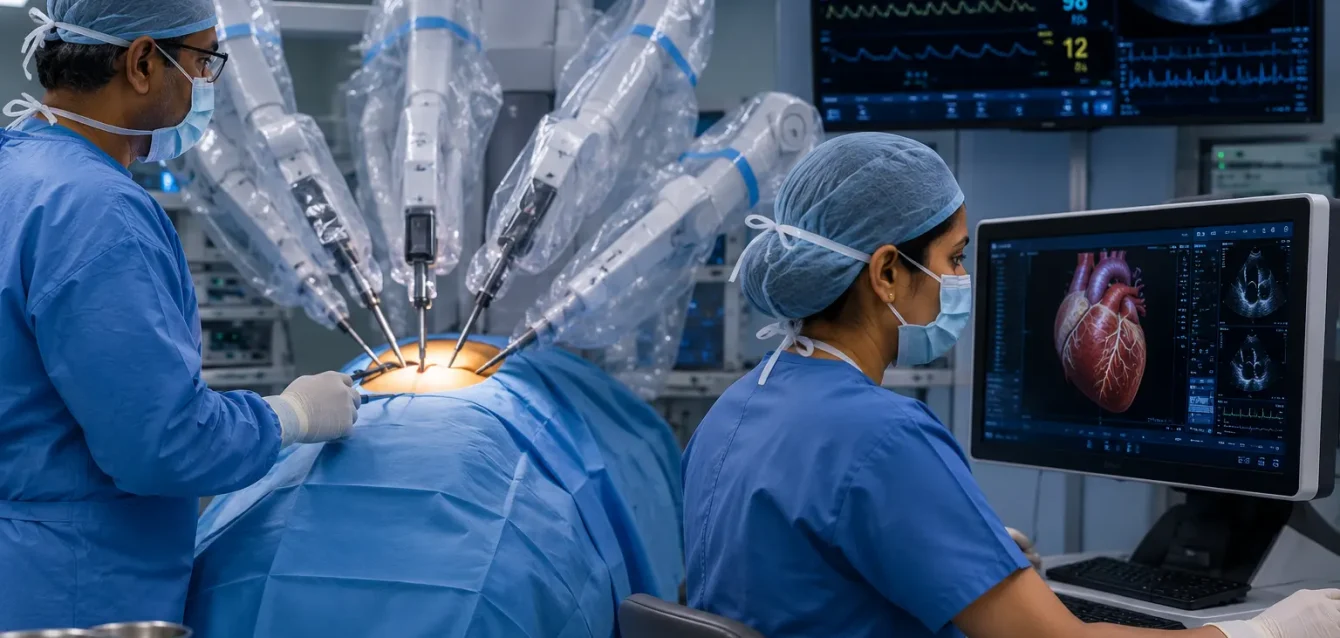
Robotic cardiac surgery is a specialised form of heart surgery performed using advanced robotic technology controlled entirely by a trained cardiac surgeon. The robot does not act independently; the surgeon operates from a console, directing miniature instruments with precision that exceeds the natural range of the human hand.
The robotic system provides:
- High-definition 3D visualisation magnified up to 10×
- Tremor filtration — eliminating natural hand movement
- Enhanced instrument dexterity in confined spaces
- Greater precision around delicate cardiac structures
How Does Robotic Cardiac Surgery Work?
The procedure follows a structured sequence:
- Small incisions (typically 1–2 cm) are made between the ribs
- Miniature robotic instruments are inserted through these ports
- A high-definition 3D camera provides a magnified view of the surgical field
- The surgeon controls robotic arms from a console
- Every movement is translated in real time into precise instrument actions inside the chest
The entire procedure typically takes 2–4 hours, depending on the complexity of the condition being treated.
What Heart Conditions Can Be Treated?
Several cardiac conditions are well-suited to robotic-assisted surgery as a primary heart surgery treatment. Suitability is always determined during a thorough specialist evaluation at Devadoss Hospital.
Mitral Valve Disease
Robotic surgery is widely used for mitral valve repair or replacement. The technique offers exceptional visualisation of valve structures and is one of the most established robotic cardiac applications globally.
Coronary Artery Disease — Selected Cases
In carefully selected patients with single-vessel disease, robotic-assisted bypass grafting may be appropriate as a specialized coronary artery disease treatment. Complex multi-vessel disease typically requires conventional surgery. For a full guide to CAD diagnosis and treatment, visit our Cardiothoracic Surgery page at https://devadosshospitals.com/cardiothoracic-surgery.
Atrial Septal Defect (ASD)
Certain congenital heart defects, including ASD, can be corrected robotically, avoiding the sternotomy that traditional repair requires.
Cardiac Tumours
Selected benign heart tumours, such as atrial myxomas, can be removed robotically with reduced surgical trauma.
Atrial Fibrillation (AF)
Specific rhythm-correction procedures, including certain surgical ablation techniques, may be performed using robotic technology.
Benefits of Robotic Cardiac Surgery
For eligible patients, robotic-assisted procedures offer meaningful advantages over traditional open-heart surgery, supported by published clinical data from the STS and cardiothoracic outcomes registries:
- Smaller incisions (1–2 cm vs. 20–25 cm) — significantly less visible scarring
- Shorter hospital stay — typically 2–4 days vs. 5–7 days for open surgery
- Faster recovery — return to normal activities in 2–3 weeks vs. 6–8 weeks
- Reduced postoperative pain — smaller wounds mean less tissue trauma
- Lower risk of wound infection — smaller entry points reduce exposure
- Less blood loss — often reduces the need for transfusion
- Enhanced surgical precision — tremor filtration and 3D magnification support accuracy
Risks and Limitations
Like all surgical procedures, robotic cardiac surgery carries risks. An honest assessment is essential when considering any intervention.
Potential risks include:
- Conversion to open surgery — if complications arise, the team will convert to a standard approach (occurs in a minority of cases)
- Longer operating time — robotic set-up may add time compared to conventional surgery
- Not suitable for all patients — emergency procedures, severe calcification, or multi-vessel disease typically require open surgery
- Outcome strongly linked to surgical experience — Devadoss Hospital’s cardiothoracic team has performed complex cardiac procedures across all techniques
- Equipment-dependent — not all hospitals in South Tamil Nadu offer a full robotic cardiac programme
A thorough pre-operative assessment with the most experienced doctors at Devadoss Hospital is the most reliable way to determine whether robotic surgery is the right approach for your condition.
Who Can Benefit?
Patients who may be suitable candidates typically have:
- Mitral valve disorders requiring repair or replacement
- Single-vessel coronary artery disease (selected cases)
- Certain congenital defects such as ASD
- Benign cardiac tumours amenable to minimally invasive removal
- AF requiring surgical ablation
Key factors evaluated during surgical assessment include the type and severity of the heart condition, overall health status, lung function, previous surgeries, and anatomical suitability.
Who May Not Be Suitable?
- Emergency cardiac procedures
- Complex multi-vessel coronary artery disease
- Severe calcification of cardiac structures
- Extensive prior chest surgery or adhesions
- Certain anatomical variations limiting robotic access
Cost, Insurance, and Procedure Duration
Procedure Duration: Robotic cardiac procedures typically take 2–4 hours, varying with condition complexity and surgical technique.
Cost: Robotic cardiac surgery generally costs more than conventional open surgery due to the technology involved. Exact costs depend on the specific procedure and individual clinical circumstances. Contact Devadoss Hospital at 95005 55344 or dmh@devadosshospitals.in for a personalised estimate.
Insurance: Devadoss Hospital is empanelled with all major insurance providers including Bajaj Allianz, ICICI Lombard, HDFC ERGO, Star Health, Manipal Cigna, and others. Many plans cover minimally invasive heart surgery procedures, subject to prior authorisation. Our team can assist with documentation and pre-authorisation – call 95005 55344 to speak with our insurance coordinator.
Recovery After Robotic Cardiac Surgery
- First 1–2 weeks: Most patients experience minimal discomfort, are mobile within 24–48 hours, and are discharged within 2–4 days.
- Weeks 2–4: Gradual return to light activity. Many patients resume desk work and non-strenuous daily tasks.
- Weeks 4–8: Progressive return to exercise and full activity, guided by your cardiac team at Devadoss Hospital.
Regular follow-up appointments are scheduled with our cardiothoracic team to monitor healing and cardiac function throughout recovery.
The Future of Robotic Heart Surgery
Robotic technology in cardiac surgery continues to evolve. At Devadoss Hospital, we remain committed to adopting advances in imaging, surgical planning, and instrumentation as they become clinically validated, ensuring our patients have access to the most effective treatments available.
Robotic Cardiac Surgery in Madurai at Devadoss Hospital
Patients seeking robotic cardiac surgery in Madurai evaluation benefit from expert surgical assessment, advanced technology, and personalized care designed to support optimal outcomes and faster recovery.
Our Cardiac Services Include:
- Robotic cardiac surgery evaluation and planning
- Mitral valve repair and replacement
- Minimally invasive bypass procedures
- Congenital heart defect correction
- Cardiac tumour removal
- Atrial fibrillation surgical treatment
- Cardiac diagnostics and preventive cardiology
- Post-surgical rehabilitation
Book an Appointment: Call 95005 55344 | Email dmh@devadosshospitals.in | Visit https://devadosshospitals.com/book-an-appointment/
Quick Heart Health Checklist
- Persistent chest discomfort or tightness
- Shortness of breath during activity
- Fatigue without clear cause
- Family history of heart disease
- High blood pressure or elevated cholesterol
- Diabetes
- Recent abnormal ECG or echo results
- Regular cardiac screenings if over 40
Final Words
Robotic cardiac surgery represents a significant advancement in heart care, offering eligible patients smaller incisions, reduced pain, and faster recovery. It is not the right approach for every patient or condition, but for those who qualify, outcomes from experienced centres are excellent.
Whether you require valve repair, selected bypass surgery, or another heart surgery treatment, consulting experienced doctors at Devadoss Hospital, Madurai is the essential first step. Early evaluation is the best investment in long-term heart health.
FAQs
Q: What is robotic cardiac surgery?
Robotic cardiac surgery is a minimally invasive heart surgery procedure in which a trained cardiac surgeon uses a robotic system to operate through small chest incisions, typically 1–2 cm with enhanced 3D visualisation and precision.
Q: How long does robotic heart surgery take?
Most robotic cardiac procedures take between 2 and 4 hours, depending on the complexity of the condition and the specific technique used.
Q: What is the success rate of robotic heart surgery?
For robotic mitral valve repair, outcomes at experienced centres exceed 95%, consistent with Society of Thoracic Surgeons data. Your surgeon can provide condition-specific outcome data at your consultation.
Q: Is robotic heart surgery covered by insurance in India?
Devadoss Hospital is empanelled with all major insurers including Bajaj Allianz, ICICI Lombard, HDFC ERGO, and Star Health. Coverage depends on your policy; our insurance coordination team can assist with pre-authorisation. Call 95005 55344.
Q: What are the risks of robotic cardiac surgery?
Risks include possible conversion to open surgery, longer operating time in some cases, and suitability limitations for emergency or complex conditions. As with any cardiac surgery, standard surgical risks apply. A specialist assessment at Devadoss Hospital will weigh risks against your individual profile.
Q: Is robotic heart surgery safer than traditional surgery?
Both approaches are safe as a heart surgery treatment when performed by experienced surgeons. For suitable candidates, robotic surgery offers smaller incisions, less blood loss, and shorter recovery. The best approach depends on the specific condition and patient factors.
Q: Can robotic surgery treat coronary artery disease?
In selected cases, particularly single-vessel disease, robotic-assisted bypass may be appropriate as a coronary artery disease treatment. Complex multi-vessel disease generally requires conventional open surgery. Our cardiothoracic team at Devadoss Hospital will advise the best approach for your case.
Q: What are the benefits of minimally invasive heart surgery?
Benefits include smaller scars (1–2 cm incisions), shorter hospital stays (2–4 days), faster recovery (2–3 weeks vs. 6–8 weeks for open surgery), reduced pain, and lower wound infection risk.