

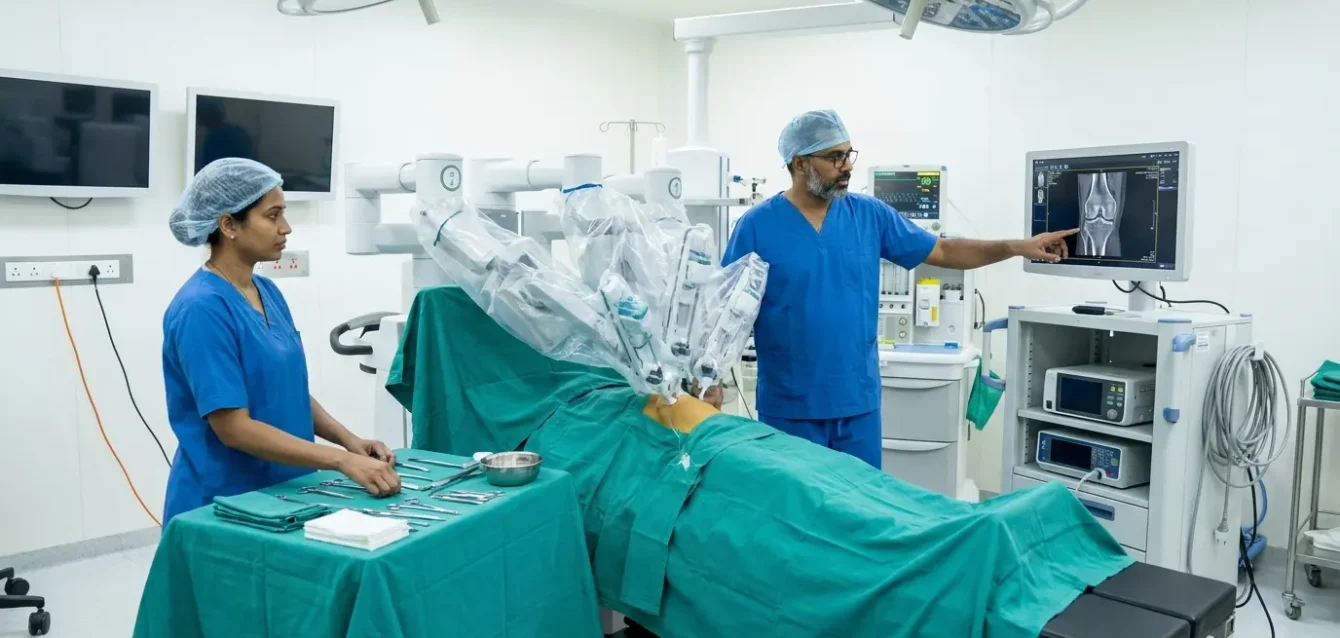
When you hear the term “robotic surgery,” you may imagine a machine performing an operation on its own. In reality, it is quite different.
Robotic orthopaedic surgery uses specialised technology to assist surgeons during certain procedures. The surgeon remains in control while the system helps with surgical planning, navigation, implant positioning and, depending on the system, specific surgical tasks.
The technology is increasingly being used in areas such as knee and hip replacement, as well as selected spinal procedures.
But what does this mean for a patient? And does having a robot involved automatically mean better surgery?
Let’s look at it simply.
What Is Robotic Surgery?
Robotic surgical systems are programmable technologies designed to support surgeons during an operation. Different systems work differently. Some guide the surgeon’s hand, while others can guide the movement of instruments or implants.
The important point is that the robot does not replace the surgeon.
The surgeon continues to make the clinical decisions and remains responsible for the procedure. The technology acts as an additional tool that can provide detailed information and assist with accuracy.
How Does Robotic Surgery Work?
The exact process depends on the robotic system being used, but many systems involve detailed planning before the procedure.
Some systems use preoperative imaging, such as CT scans, to create a three dimensional reconstruction of the patient’s joint or spine. This can help the surgeon plan implant positioning and alignment before entering the operating room.
During surgery, the system can provide real time information about the position of the joint, instruments or implants. Some systems also use navigation, optical tracking or haptic feedback to assist the surgeon.
So, rather than “the robot doing the surgery,” it is better to think of it as the surgeon working with an advanced technological system.
Where Is Robotic Technology Used in Orthopaedics?
Robotic systems are used across several areas of orthopaedic care.
The most established applications include:
- Partial and total knee replacement
- Total hip replacement
- Selected spinal procedures
Research is also exploring applications in trauma, oncology and complex reconstructive procedures.
For patients, however, the important question is not simply whether robotic technology is available. It is whether it is appropriate for their particular condition and procedure.
How Does Robotic Joint Replacement Differ?
Robotic joint replacement uses robotic assistance during procedures such as knee or hip replacement.
One of the main advantages of these systems is the ability to create a detailed surgical plan based on the patient’s anatomy. During the procedure, the technology can then assist with implant positioning and alignment.
Research has consistently found that robotic systems can improve the accuracy and reproducibility of implant positioning compared with conventional manual techniques.
However, precision is only one part of the picture. Whether these technical improvements translate into better long term function or implant survival is still being studied.
What About Robotic Knee Replacement?
The knee is one of the main areas where robotic technology is currently used.
During robotic knee replacement, the system may help the surgeon plan the procedure, assess alignment and position the implant with greater precision. Different robotic platforms use different combinations of imaging, navigation and robotic assistance.
Studies have reported benefits such as improved implant alignment and, in some cases, shorter hospital stays. At the same time, the available evidence does not consistently show superior medium or long term functional outcomes compared with conventional knee replacement.
That distinction is important.
Better technical precision does not automatically mean that every patient will have a better long term result.
What Are the Benefits?
The potential benefits of robotic orthopaedic surgery are mainly connected to precision, planning and consistency.
Depending on the procedure and system, these may include:
- More accurate implant positioning
- Improved alignment
- Greater reproducibility of the surgical plan
- Potentially fewer early revision procedures
- Potentially shorter hospital stays
Some studies have also reported improvements in early recovery, pain and patient satisfaction, although these findings are not consistent across all procedures.
It is also worth knowing that robotic procedures can sometimes take longer, particularly while the surgical team is gaining experience with the technology.
Is Robotic Surgery Better Than Conventional Surgery?
This is probably the question most patients want answered.
The honest answer is: not necessarily for everyone.
Current research shows clear improvements in technical accuracy and implant positioning with robotic assistance. But evidence about long term clinical outcomes is still evolving. Some studies have found comparable outcomes between robotic and conventional procedures, particularly when looking at longer term function and quality of life.
So choosing surgery should not be based on the word “robotic” alone.
The patient’s condition, the surgeon’s experience, the procedure being considered and the overall treatment plan all matter.
Does Robotic Surgery Mean a Robot Operates on You?
No.
The surgeon remains in control of the procedure. Depending on the system, the technology may guide the surgeon, provide navigation, assist with positioning or perform certain controlled surgical tasks.
Think of it as an advanced surgical tool rather than an independent surgeon.
What Should Patients Consider Before Choosing It?
Robotic technology is sophisticated, but the technology itself should not be the only thing you consider.
Ask your orthopaedic surgeon:
- Why do I need this procedure?
- Is robotic assistance appropriate for my condition?
- What would conventional surgery involve?
- Which robotic system will be used?
- What are the expected benefits and limitations?
- What will my recovery and rehabilitation involve?
These questions can give you a clearer picture of what the procedure means for you.
Looking for Robotic Orthopaedic Care in Madurai?
What makes our approach different is the combination of experienced orthopaedic surgical judgement with patient-specific robotic assistance. The robotic system provides guidance and precision, but the surgeon remains at the centre of the procedure, deciding how the surgery should be performed and adapting to what is encountered during the operation.
We also believe that joint replacement should not be defined by the technology used in the operating room. The real goal is functional recovery: helping the patient move better, regain independence and return to everyday activities.
So, robotic orthopaedic care at Devadoss Hospital, Madurai is not simply about having access to robotic technology. It is about using it selectively, purposefully and under the judgement of an experienced orthopaedic surgical team when it can add value for the right patient.
Frequently Asked Questions
Is robotic surgery fully performed by a robot?
No. The surgeon remains in control, while the robotic system assists with specific aspects of the procedure.
Is robotic surgery used only for knee replacement?
No. It is also used for total hip replacement and selected spinal procedures, with other applications continuing to develop.
Does robotic surgery guarantee faster recovery?
No. Some studies report shorter hospital stays and early recovery benefits, but the evidence is not uniform and long term outcomes remain under study.
Is robotic surgery more precise?
Robotic systems are designed to improve the accuracy and reproducibility of implant positioning and alignment.
Is robotic surgery suitable for everyone?
No. The suitability of the technology depends on the individual patient, the condition being treated and the procedure being planned.