

Medically reviewed by: Dr. Sathish Devadoss – M.B.B.S., M.S. (Ortho), M.Ch. Orth (UK), FASIF (Aust); Dr Sethu Kannan – M.B.B.S., M.S. Dip, MAS. FALS (Hernia), FIAGES, Dr. Jagadesh Kumar – M.B.B.S., M.S. FALS (Hernia), FIAGES.
When surgery is recommended, it is natural to wonder which approach is better. Is newer always better? Or does traditional surgery still have a place?
Surgeons use both approaches in modern care. The important difference is how the surgeon accesses the treatment area, the instruments used, and how much assistance technology provides during the procedure.
Understanding the options can help you have a clearer conversation with your surgeon before making a decision..
What Is Robotic Surgery?
Robotic surgery is a type of minimally invasive surgery that uses specialised technology to help surgeons perform procedures through small incisions.
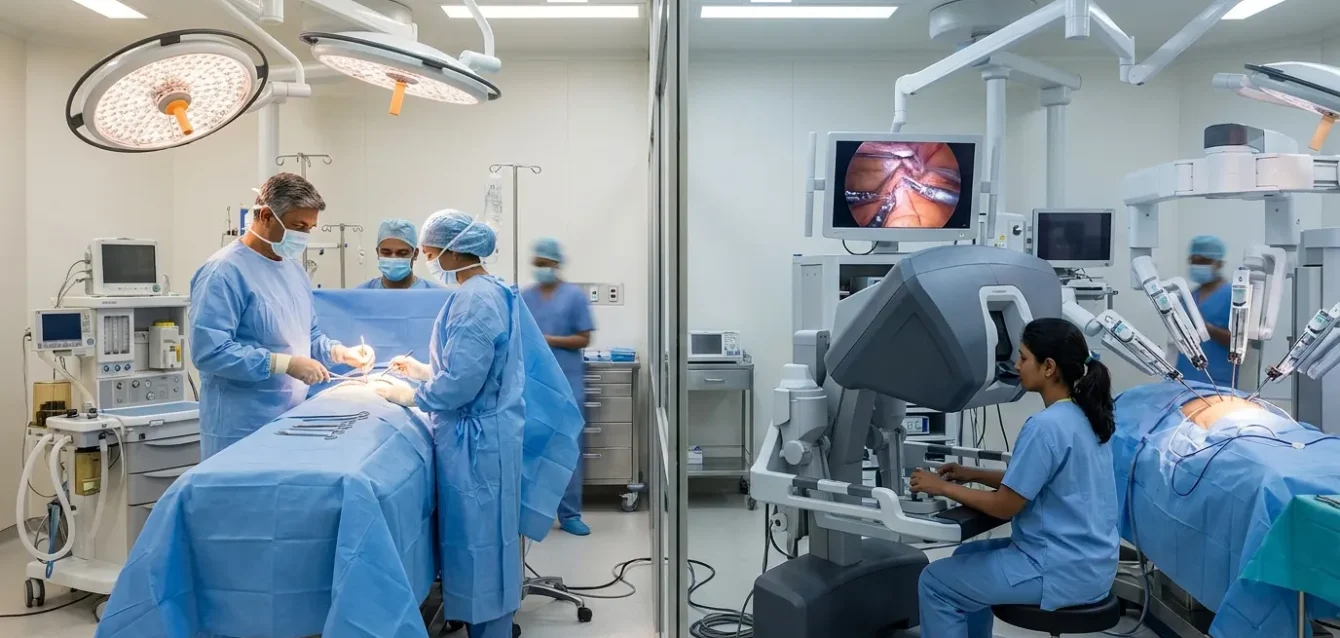
A robotic system typically includes a surgeon’s console, robotic arms with specialised instruments and a high definition 3D camera. The surgeon sits at the console and controls the instruments throughout the procedure.
The word “robotic” can sometimes be misleading. The robot does not operate independently. The surgeon remains in control and guides every movement.
The technology essentially acts as an extension of the surgeon’s hands, translating their movements into controlled actions at the surgical site.
What Is Traditional Surgery?
Traditional surgery, often referred to as open surgery, generally involves a larger incision that allows the surgeon direct access to the area being treated.
It remains an important part of surgical care and can be especially useful when a procedure requires extensive access or visibility.
Emergency operations, complex procedures and certain major surgeries may still require an open approach.
So, traditional surgery is not simply an older version of robotic surgery. In some situations, it may actually be the more appropriate option.
Robotic Surgery vs Traditional Surgery: What Is the Difference?
The difference between robotic and traditional surgery can be understood through a few important factors.
Incision size
Robotic procedures are generally performed through several small incisions. According to INTEGRIS Health, these entry points can be less than an inch.
Open surgery usually requires a larger incision to provide direct access to the surgical area.
Smaller incisions may mean less disruption to surrounding tissues, which can contribute to less postoperative pain and smaller scars.
Visualisation
Robotic systems use a high definition 3D camera that magnifies the surgical site.
This gives the surgeon a detailed view of internal structures and can be particularly useful when working in small or difficult to reach areas.
Traditional surgery provides direct visual access, which can be valuable when the surgeon needs to see and work across a larger area.
Instrument movement
Robotic instruments are designed to provide controlled and precise movements. They can also offer flexibility that can be useful during complex procedures.
The surgeon controls these instruments from the console, rather than the robotic system making decisions independently.
Scarring
Because robotic surgery generally uses smaller incisions, the resulting scars can be smaller and less noticeable.
With open procedures, the incision is larger because the surgeon needs greater physical access to the treatment area.
Hospital stay
Minimally invasive robotic procedures may allow some patients to leave the hospital sooner.
Open procedures often require a longer hospital stay, although this depends greatly on the type of surgery, the patient’s health and how recovery progresses.
What Are the Robotic Surgery Benefits?
The potential robotic surgery benefits are largely connected to minimally invasive access and the technology available to the surgeon.
These may include:
- Smaller incisions
- Less postoperative pain
- Minimal scarring
- Reduced tissue trauma
- Enhanced 3D visualisation
- Precise and controlled instrument movement
- Faster recovery in suitable procedures
- Shorter hospital stays in many cases
Robotic systems may also reduce physical strain on the surgeon during lengthy procedures because the surgeon operates from a console rather than manually manipulating conventional instruments for the entire operation.
However, these benefits can vary depending on the procedure and the individual patient.
How Does Robotic Surgery Work?
A robotic surgical system generally has three important components.
Surgeon’s console:
The surgeon views a magnified 3D image of the surgical area and controls the robotic instruments.
Robotic arms:
These hold specialised surgical instruments and reproduce the surgeon’s movements in a controlled manner.
3D camera:
The camera provides a magnified view of internal structures, allowing the surgeon to see details that may be difficult to visualise with conventional techniques.
The instruments are inserted through small access points. The surgeon then uses hand controls and foot pedals to direct their movements.
The system can also scale the surgeon’s hand movements, allowing very controlled actions at the surgical site.
Robotic Surgery vs Open Surgery: Are They the Same?
They are not the same approach.
Robotic surgery vs open surgery mainly comes down to how the surgical area is accessed.
Robotic surgery is generally minimally invasive, using small incisions and specialised instruments.
Open surgery uses a larger incision to provide direct access to the treatment area.
For suitable procedures, minimally invasive surgery may result in less pain, smaller scars and faster recovery. But open surgery can provide the wider access needed for complex or emergency procedures.
For example, INTEGRIS Health notes that open surgery may still be required for emergency operations, extensive procedures, organ transplants and certain open heart surgeries.
Does Robotic Surgery Always Mean Faster Recovery?
This is one of the questions patients ask most often.
Smaller incisions generally mean less tissue disruption. This can contribute to reduced pain and faster healing in suitable procedures.
But there is no universal robotic surgery recovery time.
Recovery depends on the procedure being performed, its complexity, the patient’s age and overall health, and whether complications occur.
A patient undergoing a relatively minor minimally invasive procedure may recover much sooner than someone undergoing a complex robotic operation.
That is why your surgeon’s expected recovery timeline is more useful than a general number found online.
What Does Research Say About Robotic Surgery?
Research suggests that robotic surgery can offer several potential advantages, but the results are not identical across every type of procedure.
A systematic review and meta analysis published in 2016 looked at 108 studies involving 14,448 patients. Overall, robotic surgery was associated with lower blood loss, lower transfusion rates, shorter hospital stays and fewer 30 day complications compared with open surgery.
However, the robotic procedures also took longer on average.
The researchers also noted that some of the advantages became less clear when the analysis was restricted to randomised controlled trials.
This is an important reminder that surgical technology should be evaluated based on the procedure, the evidence available and the individual patient rather than assuming that one approach is always superior.
Are There Any Limitations to Robotic Surgery?
Yes.
Robotic surgery requires specialised equipment, trained surgical teams and suitable infrastructure. It may therefore not be available at every hospital.
Cost can also be a consideration.
The research literature has also highlighted the need for specialised training and the possibility of longer operating times, particularly as teams gain experience with robotic systems.
Another important limitation is that not every patient is a suitable candidate.
Previous surgery may have caused scar tissue that makes access difficult. Certain anatomical factors or the complexity of the condition may also make an open procedure more appropriate.
When Is Traditional Surgery Preferred?
Traditional surgery may still be preferred when the surgeon needs extensive or immediate access to the treatment area.
This can include:
- Emergency surgery
- Extensive trauma
- Complex organ reconstruction
- Certain major cancer operations
- Organ transplantation
- Some open heart procedures
- Situations where previous surgery has caused extensive scar tissue
The decision is based on what gives the surgical team the safest and most effective access for that particular patient.
Is Robotic Surgery Right for You?
If you are considering robotic surgery in Madurai, the first step should be a detailed discussion with your surgeon.
Rather than choosing a procedure simply because it uses newer technology, ask:
- Why is robotic surgery suitable for my condition?
- What are the alternatives?
- Would open surgery be safer in my case?
- What are the expected benefits and risks?
- How long might I stay in the hospital
- What can I expect during recovery?
- How experienced is the surgical team with this procedure?
These questions can help you make a decision based on your individual condition rather than on the technology alone.
Frequently Asked Questions
Is robotic surgery performed by a robot?
No. The surgeon remains in control throughout the procedure. The robotic system assists with instrument movement and visualisation.
Is robotic surgery always better than traditional surgery?
No. Robotic surgery has potential advantages, but traditional surgery remains the better choice for certain complex and emergency procedures.
Does robotic surgery leave smaller scars?
Generally, yes. Robotic procedures usually use smaller incisions than open surgery, which can result in smaller scars.
Is recovery faster after robotic surgery?
It can be for suitable procedures, but recovery varies from one patient and procedure to another.
Can every patient undergo robotic surgery?
No. The suitability of robotic surgery depends on the patient’s condition, anatomy, previous surgeries and the type of procedure required.
What should I ask my surgeon before choosing robotic surgery?
Ask about the reason for recommending robotic surgery, available alternatives, expected benefits and risks, hospital stay, recovery and the surgical team’s experience with the procedure.
Robotic surgery has changed the way many procedures are performed, offering surgeons enhanced visualisation, controlled instrument movement and minimally invasive access.
But that does not make traditional surgery obsolete.
Sometimes smaller incisions and advanced technology can offer meaningful advantages. At other times, the wider access of open surgery is exactly what the patient needs.
The best surgical approach is ultimately the one that is safest and most appropriate for your individual condition.