

Medically reviewed by: Dr. Sathish Devadoss – M.B.B.S., M.S. (Ortho), M.Ch. Orth (UK), FASIF (Aust) , Dr. G. Balaji – M.S., M.Ch. (Plastic), DNB (Plastic)
A child’s hand plays an important role in everyday activities, from holding toys and picking up objects to eating, writing and playing. However, some children are born with conditions that affect the development and positioning of their hands. One such condition is radial club hand, a congenital deformity that affects the forearm, wrist and thumb.
For parents, noticing that their child’s wrist bends towards one side or that the thumb appears underdeveloped can raise several questions. Will the condition affect the child’s hand function? Does it always require surgery? At what age should treatment begin?
Understanding the condition and available treatment options can help parents make informed decisions about their child’s care. Radial club hand treatment in children depends on the severity of the deformity, the development of the bones and the functional needs of the child.
What Is Radial Club Hand?
Radial club hand, also known as radial dysplasia or radial longitudinal deficiency, is a rare congenital condition in which the radius, one of the two bones in the forearm, is either underdeveloped or completely absent.
The radius extends from the elbow to the wrist, alongside the ulna. When it does not develop properly, the wrist may bend towards the thumb side of the forearm. The thumb may also be smaller than usual, underdeveloped or absent.
The condition can affect one or both arms. In some children, the surrounding muscles, tendons, ligaments and joints may also be affected.
The severity varies from child to child. Some may have a mild difference in the length of the radius, while others may have a significant wrist deformity and an absent radius.
What Causes Radial Club Hand in Children?
Radial club hand develops during the early stages of pregnancy when the bones and surrounding structures of the upper limb are forming. In many cases, the exact cause is not known.
Researchers have explored possible genetic and developmental factors associated with the condition. However, it is not always possible to identify a specific reason why a child develops radial dysplasia.
In some children, radial club hand may occur alongside other congenital conditions, including:
- Fanconi anaemia
- Holt-Oram syndrome
- TAR (Thrombocytopenia-Absent Radius) syndrome
- VACTERL association
This is why doctors may recommend a detailed medical evaluation after identifying the deformity. Radial club hand deformity treatment should begin with understanding the extent of the condition and checking for any associated health concerns.
What Are the Signs and Symptoms of Radial Club Hand?
The visible signs of radial club hand may be noticed at birth. The severity of these signs depends on how much the radius and surrounding structures have developed.
Common signs include:
- The wrist bending towards the thumb side.
- A shorter or unusually shaped forearm.
- An underdeveloped or missing thumb.
- Limited wrist movement.
- Differences in the size or development of the fingers.
- Difficulty with gripping or holding objects in some cases.
Some children may adapt to the condition and develop their own ways of performing everyday activities. However, significant deformities can affect hand positioning, grip and wrist movement as the child grows.
How Is Radial Club Hand Diagnosed?
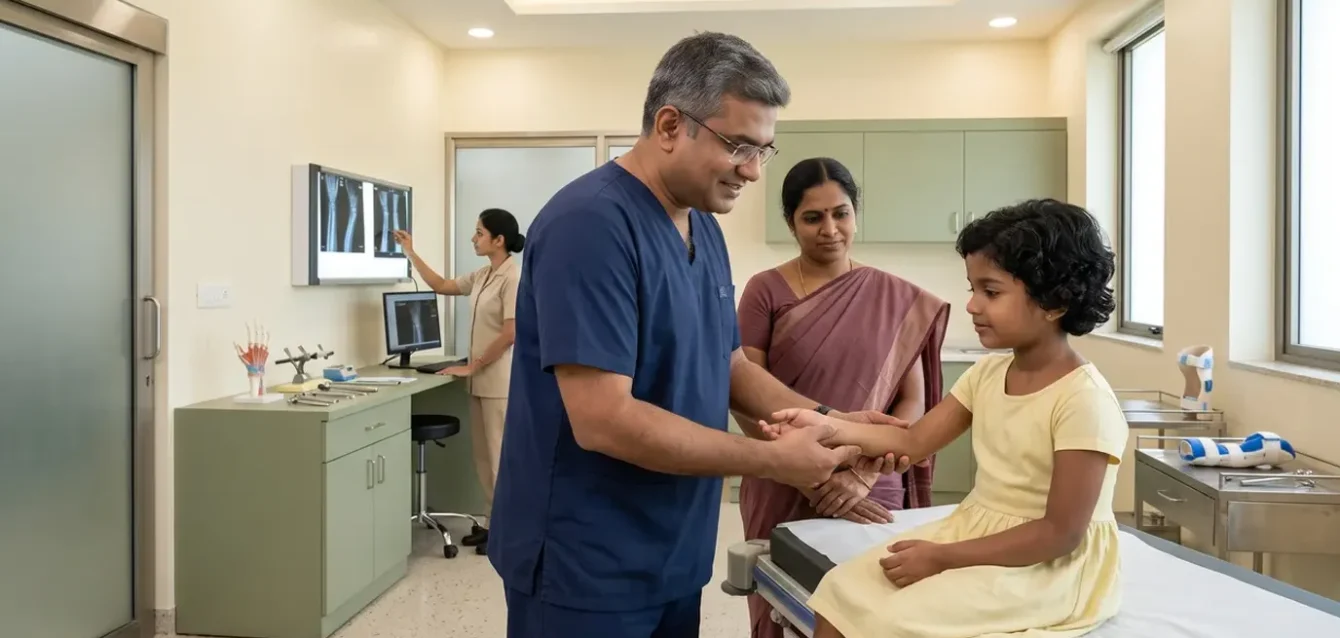
Diagnosis usually begins with a physical examination. The doctor examines the child’s wrist, forearm, thumb and fingers to understand the extent of the deformity.
An X-ray helps assess the development of the radius, ulna and wrist bones. Based on these findings, the condition may be classified into four types according to the severity of the radial deficiency.
| Type | Description |
| Type I | Mild shortening of the radius |
| Type II | An underdeveloped and shortened radius |
| Type III | Partial absence of the radius |
| Type IV | Complete absence of the radius |
Doctors may also recommend additional investigations, such as blood tests, heart and kidney evaluations or genetic assessment, depending on the child’s clinical findings. These tests help identify associated conditions that may need attention.
An early and detailed assessment helps determine the most appropriate radial club hand treatment in children.
When Is Radial Club Hand Surgery Needed?
Not every child with radial club hand requires surgery. The treatment plan depends on the severity of the deformity, wrist stability, thumb function and the child’s overall health.
Mild cases with relatively stable wrist joints may be managed with non-surgical methods. These can include:
- Stretching: Gentle exercises to improve the flexibility of tight soft tissues around the wrist.
- Splinting: Specially designed splints help maintain a better wrist position.
- Serial casting: A series of casts may gradually improve the alignment of the wrist.
- Occupational therapy: Helps improve hand use and supports the development of everyday functional skills.
Surgery may be considered when the wrist has significant radial deviation, the deformity affects hand positioning or function, or non-surgical treatment is not sufficient to achieve the desired alignment.
In more severe cases, surgery aims to improve wrist alignment and stability, provide a better position for hand function and address thumb abnormalities where necessary.
The decision about radial club hand surgery is individualised. A specialist evaluates the child’s age, bone development, joint flexibility and associated conditions before recommending a procedure.
What Does Radial Club Hand Surgery Involve?
The main goal of surgery is to improve the alignment of the wrist and make the hand more stable and functional. Depending on the child’s condition, the surgeon may recommend one or more procedures.
Wrist Centralisation
Wrist centralisation is a procedure used to correct the position of the wrist when the hand is significantly tilted towards the thumb side.
During the procedure, the surgeon releases tight soft tissues around the wrist and repositions the wrist bones over the lower end of the ulna. Temporary pins may be used to hold the corrected position while the bones and surrounding tissues heal.
This helps bring the hand into a more central position and improve wrist stability.
Radialisation
Radialisation is a surgical procedure used to correct radial club hand deformity by repositioning the hand towards the ulnar side of the wrist. The procedure aims to improve wrist alignment, enhance stability and restore muscle balance to reduce the risk of deformity recurrence.
The choice between centralisation and radialisation depends on the child’s anatomy, the severity of the deformity and the surgeon’s assessment.
Thumb Reconstruction
In some children, the thumb is significantly underdeveloped or absent. Since the thumb plays an important role in gripping, holding and picking up objects, its reconstruction may be considered.
One technique is called pollicisation. In this procedure, the index finger is repositioned and reconstructed to function as a thumb.
This is a specialised procedure that aims to improve the child’s ability to grasp and handle objects.
External Fixation
Children with severe deformities may require gradual correction of tight soft tissues before or after the main surgical procedure.
An external fixation device is a specialised frame attached outside the arm using pins. It helps gradually reposition the bones and maintain the corrected alignment.
Not every child requires this method. The surgeon decides whether it is appropriate based on the severity of the deformity and the treatment plan.
At What Age Should Radial Club Hand Surgery Be Performed?
The timing of surgery depends on the severity of the condition and the child’s individual development.
For children with severe radial club hand, wrist correction may be considered during early childhood. Some surgical approaches are performed within the first year or two of life, while others may be planned at different stages.
Thumb reconstruction may be performed as a separate procedure, depending on the child’s needs and the initial treatment.
For milder cases, doctors may recommend splinting, stretching and regular monitoring before considering surgery at a later stage.
There is no single age that applies to every child. Early evaluation is important because it allows doctors to assess the deformity, monitor growth and plan treatment at an appropriate time.
What Happens After Radial Club Hand Surgery?
Recovery depends on the type of surgery performed and the extent of correction required.
Following surgery, the child’s wrist may be supported with a cast, splint or external fixation device to maintain the corrected position. The surgeon will monitor healing through follow-up examinations and X-rays where needed.
Parents may need to follow specific instructions regarding:
- Keeping the surgical area clean and protected.
- Attending scheduled follow-up appointments.
- Monitoring for swelling, redness, discharge or signs of infection.
- Following the recommended splinting or casting routine.
- Participating in rehabilitation when advised.
Occupational therapy and guided exercises may help improve wrist movement, flexibility and hand function after the healing phase.
Regular follow-up is important because some children may experience stiffness or gradual recurrence of wrist deviation as they grow. The treatment team will monitor these changes and recommend further care if necessary.
Can Children Lead a Normal Life After Radial Club Hand Treatment?
The long-term outcome depends on the severity of the original deformity, the associated abnormalities and the response to treatment.
Surgery can improve wrist alignment, stability and the position of the hand. Thumb reconstruction, when needed, may also improve gripping and grasping abilities.
However, surgery does not always restore completely normal anatomy or movement. Some children may continue to have differences in forearm length, wrist mobility or grip strength.
With appropriate treatment, rehabilitation and regular monitoring, many children develop useful hand function and participate in everyday activities.
Parents should understand that treatment is not always a one-time procedure. As the child grows, further assessment or additional interventions may sometimes be necessary.
When Should Parents Consult a Specialist?
Parents should consider an early medical evaluation if they notice that their newborn’s wrist bends unusually, the forearm appears shorter or the thumb is underdeveloped.
Even when the deformity seems mild, an assessment can help identify the extent of the condition and rule out associated abnormalities.
Consulting a specialist early also helps parents understand whether non-surgical treatment is sufficient or whether surgery may be needed later.
Families looking for radial club hand treatment in India can consult the orthopaedic team at Devadoss Hospital for an assessment and guidance on appropriate treatment options.
Frequently Asked Questions
Is radial club hand present from birth?
Yes. Radial club hand is a congenital condition, which means it develops before birth. It affects the development of the radius bone and may also involve the wrist, thumb and surrounding soft tissues.
Does every child with radial club hand need surgery?
No. Children with mild deformities may benefit from stretching, splinting, casting and occupational therapy. Surgery is generally considered when the deformity is more severe or affects wrist alignment and function.
Is radial club hand surgery performed in stages?
In some children, yes. Wrist correction and thumb reconstruction may be performed as separate procedures. The number and timing of surgeries depend on the child’s condition and treatment requirements.
Will the child be able to use the hand normally after surgery?
Surgery aims to improve wrist alignment and hand function. However, the final outcome varies. Some children may continue to have limitations in movement, grip strength or forearm growth even after treatment.
Why is early treatment important for radial club hand?
Early evaluation helps doctors understand the severity of the deformity, identify associated conditions and plan treatment around the child’s growth and development. It also allows non-surgical methods to begin when appropriate.
Where can parents seek paediatric hand surgery in Madurai?
Parents looking for paediatric hand surgery in Madurai can approach Devadoss Hospital for specialist evaluation and guidance. The appropriate treatment depends on the child’s age, the severity of the deformity and individual functional needs.
References
- Olson N, Hosseinzadeh S. Radial Dysplasia – StatPearls. NCBI Bookshelf, updated May 1, 2023.https://www.ncbi.nlm.nih.gov/sites/books/NBK557493/
- Club Hand – International Center for Limb Lengthening.https://www.limblength.org/conditions/club-hand/