

Medically reviewed by: Dr. P.K. Prabhu (M.S.,M.Ch(Urology & Andrology)
When a doctor recommends surgery, one question naturally sits at the back of almost every patient’s mind.
“What are the chances of complications?”
It is a valid concern. Whether the surgery involves the urinary tract or the female reproductive system, patients want a treatment approach that is effective, safe and, whenever possible, easier to recover from.
This is where robotic surgery has changed the conversation.
With enhanced visualisation, greater precision and improved control of surgical instruments, robotic technology is increasingly being used for complex procedures in both urology and gynecology. But can it actually lower complication rates?
The answer is not a simple yes or no. Robotic surgery may offer important advantages in selected procedures, particularly when compared with open surgery. However, outcomes can vary depending on the condition being treated, the complexity of the procedure, the patient’s overall health and the experience of the surgical team.
What Makes Robotic Surgery Different?
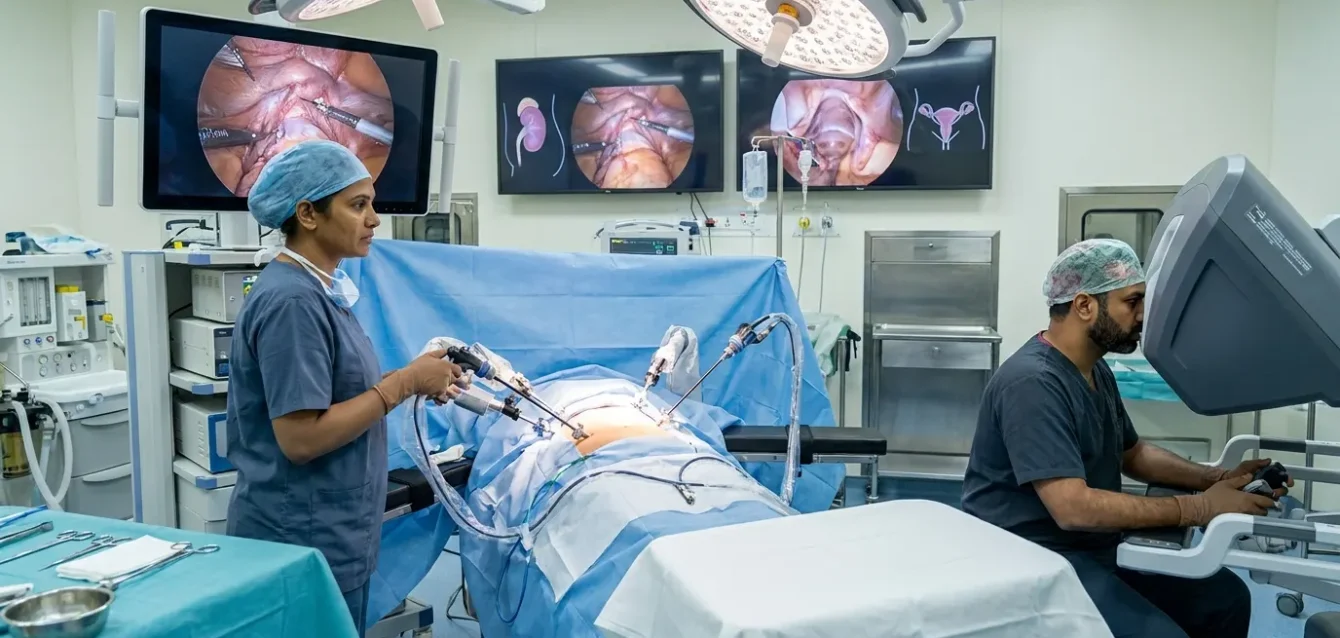
Robotic surgery does not mean that a robot performs the operation independently.
The surgeon remains completely in control. The robotic system acts as an advanced surgical platform, allowing the surgeon to operate using highly specialised instruments and a magnified view of the surgical area.
For certain procedures, this can offer advantages such as:
- Greater precision and control
- Better visualisation of delicate structures
- Smaller surgical incisions
- Improved access to difficult to reach areas
- Reduced tissue handling in selected procedures
These features can be particularly useful in areas where important nerves, blood vessels and organs are located very close to each other.
Can Robotic Surgery Reduce Complications in Urology?
Urological procedures often involve delicate structures such as the kidneys, bladder, prostate and urinary tract. In some cases, operating with precision is especially important for preserving surrounding tissues and reducing unnecessary trauma.
Robotic surgery for urology is used for selected procedures involving conditions of the prostate, kidney, bladder and other parts of the urinary system.
Compared with open surgery, robotic approaches have shown potential advantages in overall surgical outcomes in several studies. A large systematic review found lower overall complication rates with robotic surgery compared with open surgery, although the results varied across different procedures and study designs.
That said, robotic surgery is not automatically safer in every situation.
When robotic surgery is compared with other minimally invasive approaches such as conventional laparoscopy, the difference in overall complication rates is often less clear. A systematic review of robotic urological surgery also highlighted that patient selection, surgical planning and the experience of the surgical team remain critical in preventing complications.
Where Can Robotic Urology Be Useful?
Depending on the patient’s condition and the surgeon’s recommendation, robotic techniques may be considered for selected procedures involving:
- Prostate conditions
- Kidney surgery
- Bladder surgery
- Reconstructive urological procedures
- Certain complex urinary tract conditions
For patients requiring urinary tract treatment, the right approach depends on the exact diagnosis. Not every urinary condition requires surgery, and not every surgery needs a robotic approach.
The goal is always the same: choose the treatment that offers the best balance between effectiveness, safety and recovery.
What About Robotic Surgery in Gynecology?
Gynecological procedures can sometimes be technically challenging, especially when surgery involves the uterus, ovaries, pelvic organs or complex tissue planes.
Robotic gynaecology surgery in Madurai can be considered for selected patients who require minimally invasive procedures for certain benign or complex gynecological conditions.
Robotic assistance may provide the surgeon with enhanced visualisation and improved instrument movement, which can be particularly helpful in complex pelvic surgery.
Recent evidence suggests that robotic assisted gynecological surgery can have complication rates that are comparable to, and in some complex procedures potentially lower than, conventional laparoscopy. However, the evidence is procedure specific, and robotic surgery does not consistently show lower complication rates for every gynecological condition.
This distinction matters.
A patient should not be told that robotic surgery guarantees fewer complications. No surgical technique can offer that guarantee.
Instead, robotic technology can provide surgeons with another advanced option when it is appropriate for the procedure and the patient.
Robotic Surgery vs Open Surgery: Where Does the Difference Matter?
One of the strongest potential benefits of robotic surgery is its minimally invasive approach.
Instead of a large surgical incision, robotic procedures are usually performed through smaller incisions. Depending on the procedure, this may help reduce tissue trauma and can contribute to benefits such as:
- Less blood loss in selected procedures
- Smaller scars
- Reduced wound related concerns
- Shorter hospital stay in some cases
- Earlier return to normal activities for suitable patients
Studies comparing robotic and open surgery have reported lower overall complication rates in many settings, although the evidence is not identical across all operations.
So, when the question is whether robotic surgery can lower complications compared with open surgery, the answer may often be yes, for appropriately selected procedures and patients.
But when comparing robotic surgery with conventional laparoscopy, the advantage may be smaller or may not exist for every type of surgery.
Is Minimally Invasive Urine Tract Surgery Right for Everyone?
Not necessarily.
Minimally invasive urine tract surgery can be an option for certain urological conditions, but the decision depends on several factors.
These include:
- The exact location and severity of the condition
- Whether the problem involves the kidney, bladder, prostate or another part of the urinary system
- Previous surgeries
- The patient’s age and overall health
- The complexity of the procedure
- The availability of appropriate surgical expertise
Sometimes conventional laparoscopy may be sufficient. In other situations, robotic assistance may provide additional advantages. And for certain patients, open surgery may still be the safest or most effective choice.
Technology should support clinical decision making, not replace it.
The Surgeon and Surgical Team Still Matter
It is easy to focus entirely on the robot.
But the technology is only one part of the equation.
A robotic surgical system does not make decisions, identify the best treatment plan or manage complications on its own. The surgeon and the entire surgical team remain responsible for every stage of care.
Research on complications in robotic urological surgery has highlighted the importance of proper patient selection, surgical planning, positioning and surgeon experience.
In simple words, an advanced system works best in experienced hands.
That is why patients considering robotic surgery in Madurai should discuss not only the technology being used but also whether robotic surgery is actually the right approach for their specific condition.
So, Can Robotic Surgery Lower Complication Rates?
For selected urological and gynecological procedures, robotic surgery may help reduce certain surgical risks, particularly when compared with traditional open surgery.
However, it is not universally superior to conventional laparoscopy, and the difference in complication rates depends heavily on the type of procedure being performed.
The most important takeaway is this:
Robotic surgery is not simply about using advanced technology. It is about using the right technology for the right patient, at the right time.
For someone considering urological surgery, gynecological surgery or another minimally invasive procedure, a detailed consultation can help determine which approach is most suitable.
At Devadoss Hospital, the focus is on evaluating every patient individually and selecting an appropriate surgical approach based on the condition, complexity of the procedure and overall patient needs.
FAQs
Does robotic surgery guarantee fewer complications?
No. Robotic surgery cannot guarantee that complications will not occur. It may offer advantages for selected procedures, but outcomes depend on the patient’s condition, the type of surgery and the experience of the surgical team.
Is robotic surgery better than laparoscopic surgery?
Not always. For some procedures, robotic surgery and conventional laparoscopy can have similar outcomes. Robotic assistance may be particularly useful in certain complex surgeries where enhanced visualisation and instrument control can help the surgeon.
What conditions can be treated with robotic surgery for urology?
Robotic techniques may be used for selected procedures involving the prostate, kidneys, bladder and other complex urological conditions. The appropriate treatment depends on the patient’s diagnosis.
Can robotic surgery be used for gynecological conditions?
Yes. Robotic surgery may be considered for selected gynecological procedures involving the uterus and other pelvic organs. Whether it is appropriate depends on the condition and the complexity of the surgery.
How do I know if robotic surgery is right for me?
The best way is to discuss your condition with a qualified specialist. Your doctor can explain the available treatment options and recommend the approach that is most suitable for your individual needs.
References
- Complications in robotic urological surgeries and how to avoid them: A systematic review — 2017, PMC. https://pmc.ncbi.nlm.nih.gov/articles/PMC6104661/
- Robotic surgery in comparison to the open and laparoscopic approaches in the field of urology: a systematic review — 2022, PubMed. https://pubmed.ncbi.nlm.nih.gov/35526260/
- Comparative functional, perioperative and oncological outcomes of robot-assisted and open radical prostatectomy: a systematic review and meta-analysis https://link.springer.com/article/10.1007/s11255-026-05182-5