

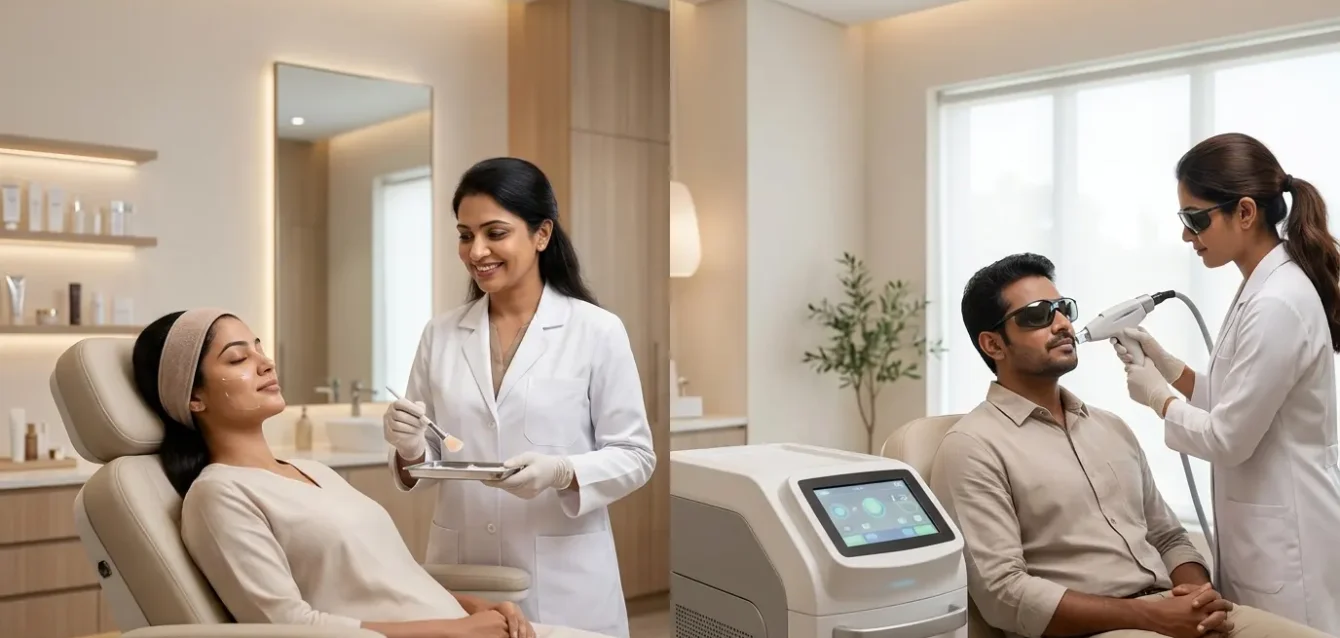
Medically reviewed by: Dr. Hema Sathish – M.B.B.S., D.D. (UK) and Dr. Deepika – M.B.B.S.,M.D.(DVL)
When it comes to skin concerns, there is rarely one treatment that works for everyone.
You may be dealing with acne scars that refuse to fade, pigmentation that keeps coming back, fine lines that have become more noticeable or simply skin that looks tired and uneven.
Then comes the big question.
Should you choose a chemical peel or laser treatment?
Both treatments can be used for skin rejuvenation, but they work differently. The right choice depends on your skin concern, skin type, the depth of the problem and the results you are hoping to achieve.
Let’s understand the difference.
What Are Chemical Peels?
As the name suggests, chemical peels for skin involve the application of a specially formulated chemical solution to the skin.
The treatment helps remove or exfoliate damaged outer layers of the skin in a controlled manner. As the skin heals, it may appear smoother, clearer and more even in tone.
Chemical peels are available in different strengths and depths.
Some are mild and may involve little downtime, while deeper peels can require a longer recovery period.
Depending on the type of peel and your individual skin condition, chemical peels may be considered for concerns such as:
- Uneven skin tone
- Mild pigmentation
- Acne and acne marks
- Sun damage
- Dull looking skin
- Fine lines
- Certain types of superficial scars
The key word here is appropriate.
A chemical peel that works well for one person’s skin may not be suitable for another. The concentration, type of peel and duration of application should be chosen based on a professional skin assessment.
What Is Laser Treatment for the Skin?
Laser treatment uses focused light energy to target specific structures or layers within the skin.
Different types of lasers may be used depending on the concern being treated.
Some laser treatments work by targeting pigmentation, while others may stimulate skin remodelling or help improve the appearance of scars and uneven texture.
Laser treatment in Madurai may be considered for a range of dermatological concerns, depending on the type of technology available and the patient’s skin condition.
Laser procedures may be used for concerns such as:
- Acne scars
- Pigmentation
- Uneven skin texture
- Sun damage
- Fine lines
- Enlarged pores
- Certain skin rejuvenation concerns
However, laser treatment is not one single procedure.
Different laser technologies work in different ways. That is why choosing a treatment based only on a friend’s experience or a social media before and after picture may not always be a good idea.
Chemical Peels vs. Laser Treatments: What Is the Main Difference?
The simplest way to understand it is this.
A chemical peel uses a chemical solution to create controlled exfoliation of the skin.
A laser uses focused light energy to target specific skin structures or layers.
Both treatments can support skin renewal, but the way they achieve this is different.
|
Chemical Peels |
Laser Treatments |
|
Use specially formulated chemical solutions |
Use focused light energy |
|
Often target the outer layers of the skin, depending on peel depth |
Can target specific layers or structures depending on laser type |
|
May be useful for pigmentation, dullness and superficial concerns |
May be considered for pigmentation, scars, texture and other concerns |
|
Downtime varies depending on peel strength |
Downtime varies depending on the laser procedure |
|
Treatment can be selected based on skin type and concern |
Laser type and settings need to be selected carefully for the individual |
Neither treatment automatically wins.
The better option is the one that matches your skin.
When Can Chemical Peels Be a Good Option?
Chemical peels may be considered when the main concerns involve the surface or upper layers of the skin.
For example, a dermatologist may recommend a suitable peel for:
Mild Pigmentation
Certain superficial pigmentation concerns may respond to carefully selected chemical peels.
Acne and Acne Marks
Some chemical peels may help improve active acne and reduce the appearance of post acne marks, depending on the individual’s skin condition.
Dull and Uneven Skin
When the skin looks tired, rough or uneven, controlled exfoliation may help improve its overall appearance.
Fine Lines and Early Signs of Ageing
Certain peels may support skin renewal and improve the appearance of fine lines.
The treatment plan may involve more than one session, depending on the type of peel and the concern being addressed.
When Can Laser Treatment Be a Better Option?
Laser treatment may be considered when a dermatologist needs to target a specific skin concern with greater precision.
For some patients, laser procedures may be recommended for:
Acne Scars
Certain laser technologies can help improve the appearance of acne scars by supporting skin remodelling.
Skin Texture Concerns
Laser treatments may help address uneven skin texture and certain types of visible scarring.
Pigmentation
Some lasers can target specific pigments in the skin. However, careful evaluation is particularly important because the wrong laser settings or treatment approach may increase the risk of pigmentation changes in some skin types.
Skin Rejuvenation
Certain laser procedures may be used to improve the appearance of fine lines, texture and overall skin quality.
For people considering skin rejuvenation treatment in Madurai, the best option may be a chemical peel, laser treatment or a combination of treatments depending on the skin concern.
Which Treatment Has Less Downtime?
This depends on the treatment.
A mild chemical peel may involve minimal downtime, while a deeper peel can require a longer recovery period.
Similarly, some laser treatments allow patients to return to their routine relatively quickly, while more intensive procedures may cause redness, swelling or peeling that takes longer to settle.
So, instead of asking:
“Which treatment has zero downtime?”
It may be more useful to ask:
“What level of improvement can I expect, and what recovery time is appropriate for that treatment?”
Your dermatologist can help you balance results with recovery time.
What About Indian Skin Types?
This is an important consideration.
Indian skin tones can be more prone to post inflammatory pigmentation after certain procedures.
That does not mean chemical peels or laser treatments cannot be performed. It means the treatment needs to be selected carefully.
The type of chemical peel, laser technology, treatment settings and post treatment skincare should all be tailored to the individual’s skin type and concern.
This is one reason why professional dermatology treatment in Madurai is important when considering procedures that intentionally create controlled changes in the skin.
A treatment that is too aggressive can sometimes create the very pigmentation problem you were trying to correct.
Can Chemical Peels and Laser Treatments Be Combined?
In some cases, yes.
A dermatologist may recommend a combination approach when different skin concerns require different treatment methods.
For example, one treatment may focus on pigmentation while another may address acne scars or skin texture.
However, combination treatments should be planned carefully. Doing multiple procedures too aggressively or too close together can irritate the skin and increase the risk of complications.
Skin rejuvenation is not about doing the maximum number of treatments.
It is about doing the right treatment at the right time.
How Do You Choose the Right Treatment?
Before deciding between a peel and a laser, consider these factors:
1. What Is Your Main Skin Concern?
Pigmentation, acne scars, active acne, fine lines and uneven texture may require different approaches.
2. What Is Your Skin Type?
Skin tone, sensitivity and previous reactions to treatments can influence which procedure is suitable.
3. How Much Downtime Can You Manage?
Some treatments may cause visible redness or peeling for a few days or longer.
4. What Results Are You Expecting?
Realistic expectations are important. Some concerns may require multiple treatment sessions rather than one dramatic procedure.
5. Have You Been Properly Evaluated?
This is probably the most important step.
A dermatologist can identify whether the pigmentation, scar or texture concern actually requires a peel, laser treatment or another approach entirely.
Chemical Peel or Laser: So, Which One Is Right for You?
There is no universal answer.
If your concern is mainly superficial pigmentation, dullness or mild acne marks, a carefully selected chemical peel may be an appropriate option.
If you have deeper acne scars, significant texture concerns or a condition that may benefit from targeted light based technology, a laser procedure may be considered.
But sometimes, the answer is neither.
Certain skin concerns may respond better to medication, skincare, other procedures or a combination of treatments.
The goal of dermatology treatment in Madurai should not be to choose the most advanced sounding procedure.
It should be to understand your skin first.
The Bottom Line
Chemical peels and laser treatments can both play a role in improving the appearance of the skin.
Chemical peels work through controlled exfoliation, while laser treatments use focused light energy to target specific concerns.
The right choice depends on your skin type, the concern being treated, the depth of the problem and your expected recovery time.
Before choosing chemical peels for skin or a laser procedure, it is always better to undergo a proper dermatological assessment.
At Devadoss Hospital, patients can consult the appropriate specialists for an evaluation of their skin concerns and guidance on suitable treatment options based on their individual skin condition.
Because when it comes to skin rejuvenation, the best treatment is not always the strongest one.
It is the one your skin actually needs.
FAQs
Are chemical peels better than laser treatments?
Neither treatment is universally better. Chemical peels and laser treatments work differently, and the right choice depends on the individual’s skin concern, skin type and treatment goals.
Can chemical peels remove pigmentation?
Certain chemical peels may help improve superficial pigmentation. However, the cause and depth of pigmentation should be assessed before treatment.
Is laser treatment painful?
The level of discomfort depends on the type of laser treatment being performed. Your dermatologist can explain what to expect and whether any measures are needed to improve comfort during the procedure
How many sessions are needed for skin rejuvenation?
The number of sessions depends on the treatment, the skin concern and the individual’s response. Some people may require multiple sessions for noticeable improvement.
Can laser treatment or chemical peels cause pigmentation?
Both procedures can potentially cause skin irritation or pigmentation changes, particularly if they are not appropriately selected or if post treatment instructions are not followed. Professional evaluation and proper aftercare are important.
References
- Chemical peels: Overview –https://www.aad.org/public/cosmetic/younger-looking/chemical-peels-overview?
- Comparative Efficacy and Safety of Laser versus Chemical Skin Peeling in Skin Rejuvenation: A Systematic Review and Meta-Analysis – Dec 2025 –https://pubmed.ncbi.nlm.nih.gov/41400370/
- Exposure to radiation –https://www.who.int/tools/occupational-hazards-in-health-sector/exposure-to-radiation?
- Seventy-eighth World Health Assembly – 2025 May –https://www.who.int/news/item/24-05-2025-seventy-eighth-world-health-assembly—daily-update–24-may-2025/?
- 10 tips for clearing acne in darker skin tones – https://www.aad.org/public/diseases/acne/diy/skin-color?